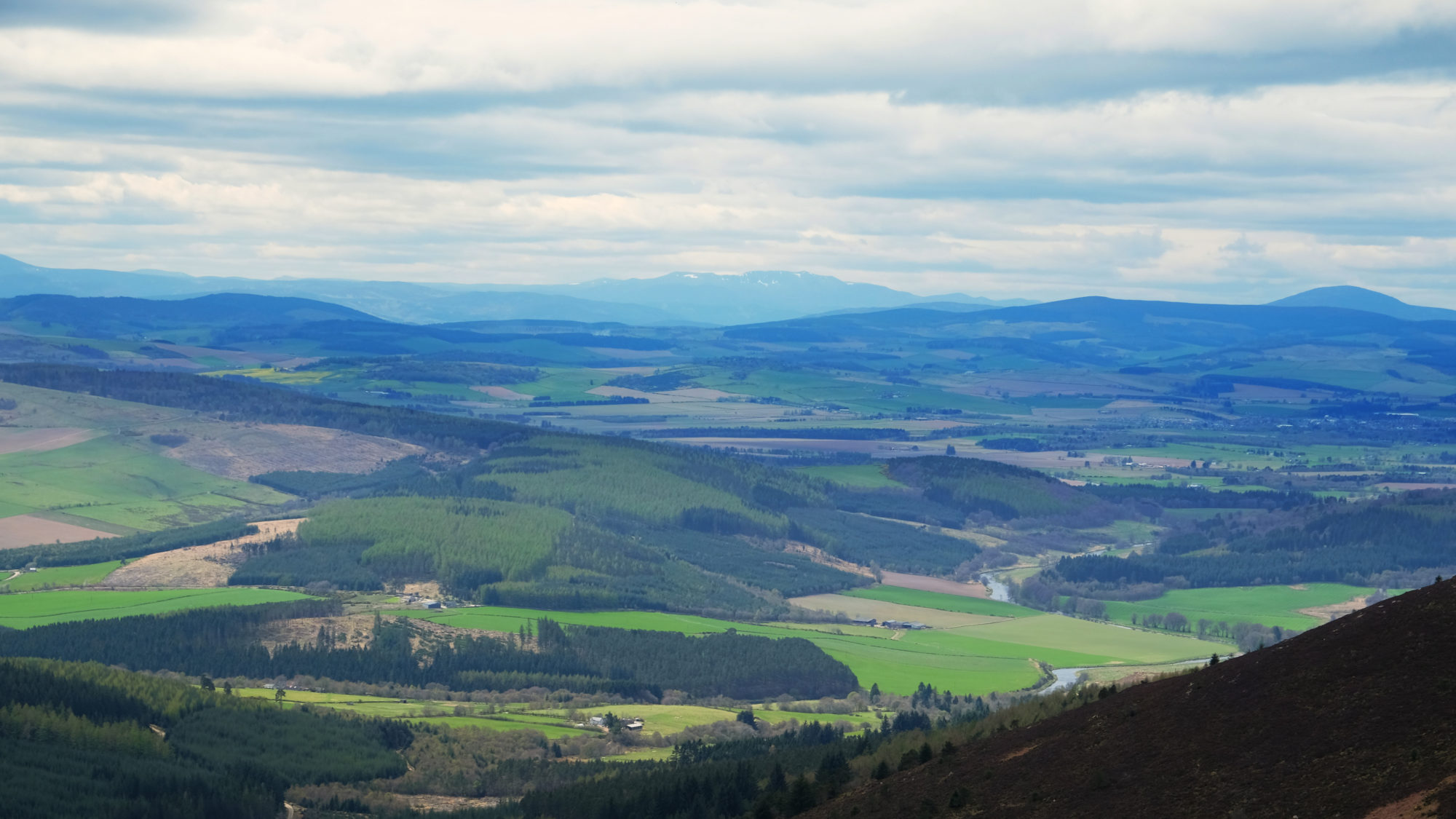
‘On several occasions widely spaced in time I dreamed of a landscape, which I had no memory of having actually visited. I stood on a high plateau, immense and flat beneath an intensely blue sky. There were no people to be seen, but strange bright columns surrounded me, clear-edged masonry like that of temples and towers. The dream brought a great sense of exhilaration, of having reached a place infinitely more worth lingering in than the humdrum localities of everyday life; and immeasurably remote from them all. My paradise-landscape lay neither north nor south, east nor west of any place on any map. It did not participate in the successiveness of time: its buildings were neither ancient nor modern; and I who watched them was neither young nor old. The details of the dream vanished on waking, but not the haunting sense of the ‘numinous’, the combined dread and exaltation of mind, which remained for some days. These dreams continued to puzzle me until a recent stay in Edinburgh.
While sitting reading on the Calton Hill I noticed an odd familiarity and unexpected impressiveness about one of the fantastic (and much maligned) monuments with which the hill is crowned. A gradual association of ideas led back to the dreams; although the place where I sat, in the middle of the city (admittedly a small plateau, and clustered with columns and an artificial temple), had nothing whatever of the atmosphere of my dream landscape. But the more I associated, the more convinced I became that the landscapes were “geographically” one and the same.
But what of the transformation of atmosphere? The answer came by recalling that the first time I visited Edinburgh and that hill was as a very small child; a child to whom the monuments would have been frighteningly large, the hill immeasurably high and cut off from the world below. The impact of that experience was not blunted at the time either by the adult habit of keeping track of movements in space on the map of the mind, or by an adult’s punctuation of time into hours and minutes. The original memory, sliding up in dream-imagery, brought with it that child’s vision intact, very different from the adult response to any possible landscape, therefore not to be found on any travel; remote and unearthly: understandably so.
In being “explained”, the dream has not lost its interest or much of its value. But one lesson could not be dodged, that the transition from “numinous awe” to “therefore experience of the transcendent” of the “wholly other” is far from a reliable one, cannot honestly be called immediate or self-authenticating. Again the religious man is entitled to say that my dream-memory may still be what I originally was tempted to take it as some sort of “intimation of immortality”, in this case preserved from the clear vision of childhood. And he could be right. Only, my confidence that he may be right is weakened by realizing that even on a sceptical view a childhood memory might reassert itself in adulthood with precisely the same sense of remoteness and discontinuity. Also, I seem able to trace the line along which the child’s unreflecting vision slowly changes into the adult’s workaday vision, with a confidence which I cannot muster for threading the analogical movement from human encounters to encounters with the transcendent.’
Ronald W. Hepburn, Christianity and Paradox: Critical Studies in Twentieth-Century Theology. New York: Pegasus, 1968, 46–7.
‘If the situation were not ambiguous, if God were incontrovertibly revealed, then our belief would be constrained, our allegiance forced, and no place would be left for free and responsible decision whether to walk in God’s ways and to entrust oneself to him in faith. Divine elusiveness is a necessary condition of our being able to enter upon properly personal relations with God.’
Ronald W. Hepburn, From World to God. Mind 72 (1963): 40–50, 50.
‘